A lightweight, hackable mini-OpenCode written in Python.
FSM-driven execution · OpenAI-compatible · built for daily use and easy customization


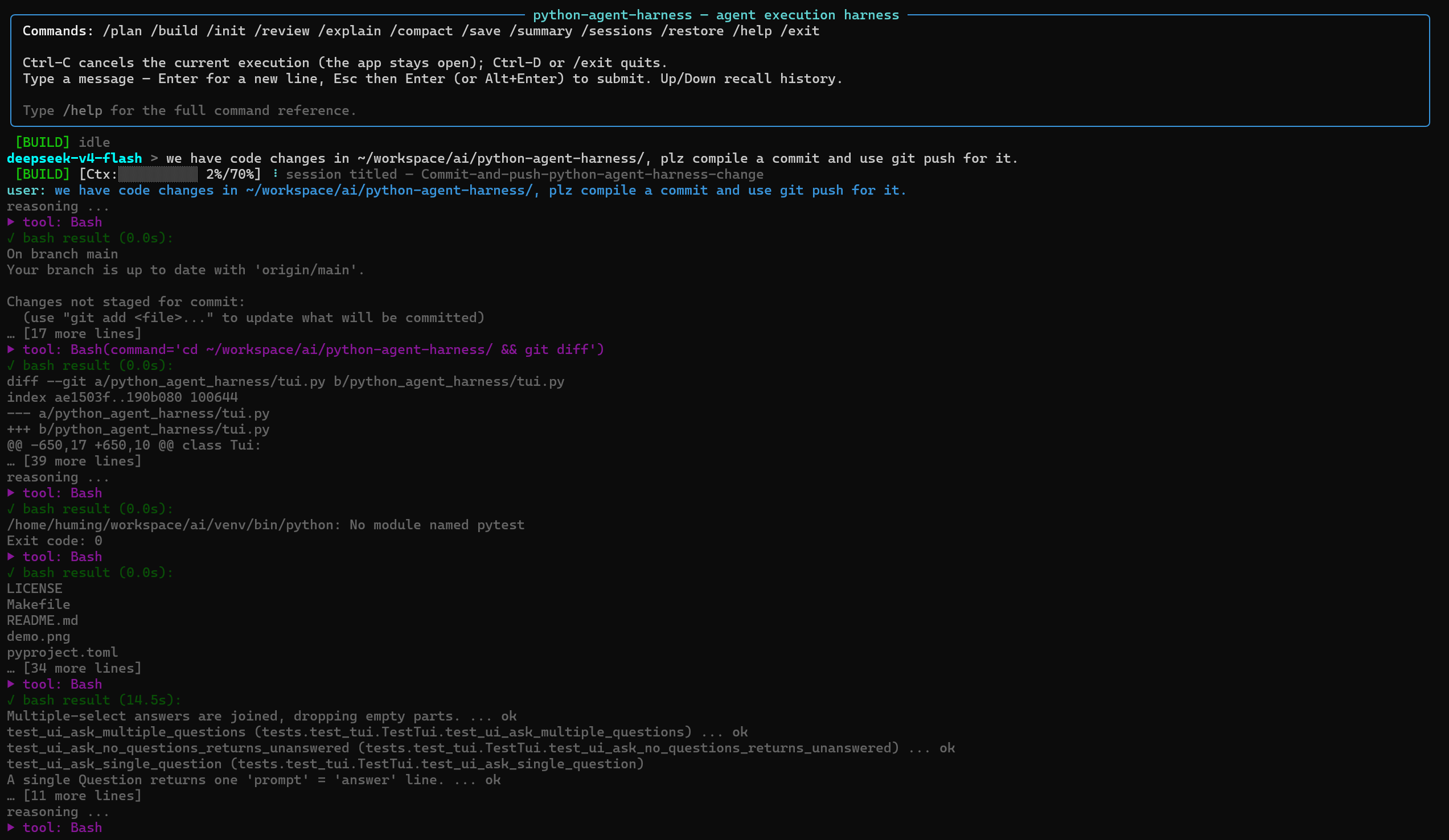
A terminal coding agent that reads your codebase, plans changes, edits files, runs commands, and verifies its work.
Inspired by gptel-agent-harness and opencode. It brings opencode's prompts and core behaviors — AGENTS.md discovery, plan/build modes, skills, sub-agents, todo tracking — into a lightweight Python implementation with only three runtime dependencies: rich, httpx, prompt_toolkit.
Works with any OpenAI-compatible API.
pip install python-agent-harness          # or: pip install -e ".[dev]" from source
python-agent-harness config --init
python-agent-harness run
Optional extras: [mcp] for MCP server integration, [dev] for development tools.
Edit ~/.config/python-agent-harness/config.json and set your base_url, api_key, and model.
- FSM-driven execution — explicit
WAIT/TOOL/TRET/SUPERVISE/DONE/ERRS/ABRTstates. Completion supervision nudges the model when it stops early; failed tool calls are sanitized. Transient API failures (429/5xx) retry with exponential backoff. Auth-expired codes (configurable viaAUTH_REFRESH_STATUS_CODESinconfig.py; defaults to[401, 502]) trigger automatic API key re-read from config/env. - Context management — CJK-aware token estimation, per-model context windows, automatic compaction at 70% usage.
- Image & text attachments — attach with
@path(e.g.@screenshot.png,@README.md): images (PNG/JPEG/GIF/WebP, up to 20 MB) become multimodalimage_urlparts; text files are inlined. Web URLs supported for images. - Coding tools —
Agent,TodoWrite,Glob,Grep,Read,Insert,Edit(incl. unified diffs),Write,Mkdir,Bash,Skill,Question,LSP,PlanExit. Read-only tool rounds (Read,Glob,Grep,Skill,LSP) dispatch concurrently; async tools (Bash,Agent) can also run concurrently. Results always delivered in emitted order. - Plan / Build modes — plan mode is read-only except for the per-session plan file.
- Persistent sessions — auto-saved after every response to
~/.local/share/python-agent-harness/sessions/, with LLM-generated titles and/restore --latest//sessions. - Focused TUI — Rich-based with pinned status bar, Todos panel, inline diff rendering, and a
prompt_toolkiteditor with history and completion.Esc+Entersubmits,Ctrl-Dquits,Ctrl-Ccancels. - MCP support — optional via
[mcp]extra. MCP tools become ordinary agent tools (mcp__<server>__<tool>). Supportsstdio,streamable-http, andssetransports. - Slash commands — built-in
/init,/review,/explain, etc., plus custom commands fromprompts/commands/*.md. - Custom agents — switch the main agent's system prompt at runtime with
/agent. Agent files live inprompts/agents/*.mdand supportname:andexclude_tools:frontmatter. - Embeddable runtime boundaries —
headless --jsonfor one-shot CI/scripting;servefor hosting apps (resident process, bidirectional protocol: multi-turn memory, mid-run Q&A, protocol-level cancel).
python-agent-harness run [--project DIR]python-agent-harness headless [prompt] [--project DIR] [--restore [SPEC]] [--model NAME] [--json]Runs a single prompt without the TUI — for CI, scripting, and piping. The assistant's answer goes to stdout; tool/status events go to stderr. Interactive prompts are auto-answered (confirm → yes, ask → "Unanswered").
- Prompt is a positional argument; when omitted, read from stdin.
--restorecontinues a saved session. Bare--restoreuses the most recent; a SPEC may be a file path or title substring.--model NAMEselects a profile from themodelsconfig section, or a raw model name on the configured endpoint.--jsonemits JSON lines on stdout:start,delta,notify,log, and a finalresult(with structurederrors). Each line carriesprotocol(wire schema version) andseq(monotonic counter). Exit code 0 on success, 1 on error.
python-agent-harness serve [--project DIR] [--answer-timeout SECONDS] [--max-rounds N] [--timeout SECONDS]A persistent, bidirectional runtime for hosting applications. Keeps the Controller/Session resident so the host can submit multiple prompts, answer mid-run questions, and cancel runs via protocol messages. See docs/serve-protocol.md for the full protocol specification.
| Command | Description |
|---|---|
/plan / /build |
Switch between read-only plan mode and build mode |
/init |
Create or update AGENTS.md |
/review |
Review uncommitted changes, commits, branches, or pull requests |
/explain [project] [target] |
Explain code |
/compact |
Compact the conversation |
/summary |
Append a conversation summary |
/save |
Save the current session |
/sessions |
List saved sessions |
/restore [path|title|--latest|latest] |
Restore a session (substring search) |
/clear |
Start a fresh conversation |
/model [name] |
Switch LLM profiles; default restores original |
/agent [name] |
Switch agent prompt; default restores built-in |
/help |
List available commands |
/exit |
Quit |
Custom commands from prompts/commands/*.md are also registered (TUI only).
Agent files are markdown (.md) in prompts/agents/. Each becomes a switchable profile via /agent. Optional YAML frontmatter:
name:— override the agent name (defaults to file stem)exclude_tools:— list of tool names to hide. Matches by exact name, glob (mcp__git__*), or__-delimited prefix (mcp__githidesmcp__git__list_reposbutWritedoes NOT hideTodoWrite).
Commands vs Agents: Commands (/review) are one-shot with a hardcoded kickoff and reset after run. Agents (/agent reviewer) persist until the next /agent, let the user type their own prompt, and stay active after Ctrl-C.
All LLM settings live in ~/.config/python-agent-harness/config.json. Environment variables are optional.
{
  "llm": {
    "base_url": "https://api.openai.com/v1",
    "api_key": "sk-...",
    "model": "gpt-5-mini",
    "reasoning_effort": null,
    "stream": true,
    "supports_image_input": false
  },
  "models": {
    "deepseek": { "base_url": "https://api.deepseek.com/v1", "model": "deepseek-chat" },
    "qwen": { "base_url": "https://dashscope.aliyuncs.com/compatible-mode/v1", "model": "qwen3.5-coder" }
  },
  "context_windows": {
    "deepseek-v4": 1000000
  },
  "paths": {
    "context_path": null,
    "skill_path": null
  },
  "mcp": {
    "servers": {
      "example": {
        "transport": "stdio",
        "command": "npx",
        "args": ["-y", "@modelcontextprotocol/server-filesystem", "/tmp"],
        "env": [],
        "parallel": false,
        "timeout": null,
        "enabled": false
      }
    }
  }
}llm— main LLM config. Optional keys:temperature,max_tokens,timeout,reasoning_effort,stream,supports_image_input.run --no-streamoverridesstream.supports_image_input(defaultfalse) controls whether@pathimages are sent or stripped.models— named LLM profiles for/modelswitching. Partial settings; unset keys inherit fromllm.defaultrestores the main config.context_windows— per-model context-window overrides (tokens). Keys are model names or substrings; first match wins. OverridesCONTEXT_WINDOWSinconfig.py.subagent_llm— LLM config forAgenttool. Unset values inherit fromllm. Setprofileto reuse amodelsentry. Precedence: profile >subagent_llm>llm> env vars.default_agent— agent name to use at session start (must exist inprompts/agents/).null= built-in default.paths.context_path/paths.skill_path— locations for context files and skills. Default: project-localcontexts/andskills/.lsp.servers— per-extension LSP server overrides for theLSPtool. Keys are extensions (.py,.cpp); each hascommand(argv) and optionallanguage_id. Layers on top ofDEFAULT_SERVERSinlsp/manager.py.mcp.servers— MCP server config (requires[mcp]extra). Each supportstransport,command,args,env,url,headers,parallel,timeout,enabled.headless/serve— optional budget limits:max_rounds(LLM rounds) andtimeout(wall-clock seconds).--max-rounds/--timeoutoverride per call;<= 0ornulldisables. Unset = unlimited.- Precedence — code defaults < config file <
OPENAI_*env vars. Sub-agents also supportOPENAI_SUBAGENT_*(_BASE_URL,_API_KEY,_MODEL). - Custom config —
--config PATHorPYTHON_AGENT_HARNESS_CONFIGenv var. - LLM logging — request/response bodies logged as JSON to
/tmp/python-agent-harness-<date>-<id>.json. SetLLM_LOG_DIRto change. Path printed at startup.
Most of opencode's prompts and core behaviors have been ported. The goal: retain its practical coding-agent workflow while keeping the implementation small and easy to customize.
| opencode | python-agent-harness |
|---|---|
default.txt (main agent) |
agent.md |
plan.txt / plan-mode.txt / build-switch.txt |
plan.md / plan-mode.md / build-switch.md |
task.txt (sub-agent) |
subagent.md + Agent tool |
todowrite.txt / question.txt / skill.txt |
TodoWrite / Question / Skill tools |
read.txt / write.txt / edit.txt / grep.txt / glob.txt |
Read / Write / Edit / Grep / Glob tools |
shell.txt |
Bash tool + agent.md Git/GitHub guidance |
plan-enter.txt / plan-exit.txt |
PlanExit tool |
initialize.txt / review.txt / explain |
initialize.md / review.md / commands/explain.md |
| compaction / summary / title | compact.md / summary.md / title.md |
AGENTS.md handling |
prompts.py (find_agents_md_files, load_context_files) |
Requires Python ≥ 3.11. CI runs against 3.11, 3.12, and 3.13 on Linux and macOS.
make test                           # unit tests
venv/bin/pip install -e ".[dev]"    # development tools
venv/bin/ruff check .               # lint
venv/bin/ruff format --check .      # formatting (CI blocks on this)
venv/bin/pyright                    # type checking
venv/bin/python -m build            # build sdist + wheel
venv/bin/pip-audit # dependency audit- gptel-agent-harness — the Emacs-based implementation that inspired this project.
- opencode — the primary source of many prompts and coding-agent behaviors.
MIT